Older Growing Rods Require Multiple Surgeries
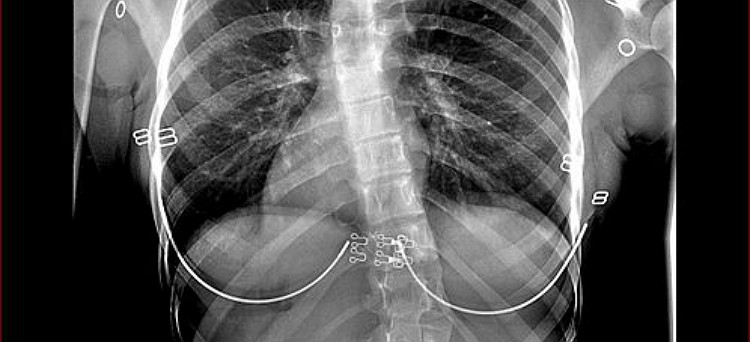
One or two growing rods are attached on either side of the spine to gradually correct the abnormal curvature characteristic of scoliosis. It's an effective method, say researchers at the University of Minnesota, but also "requires repeated invasive surgical lengthening under general anesthesia."
Since early-onset scoliosis is only diagnosed in children under the age of 10, patients continue to develop physically after their first growing rods are implanted. To account for these normal changes in growth, and reduce the risk that the spine's curvature will come to impair lung and heart development, surgeons must periodically replace a child's growing rods for a new set.
Children usually undergo another invasive surgery every six to eight months. Some patients will have to endure as many as 20 procedures before their treatment is complete, Boston Children's Hospital reports. And then, after the growing rods have finally been removed, many children will have to face a spinal fusion surgery.
How The Magec System Is Different
The Magec System was created to solve this problem.
San Diego-based medical device manufacturer NuVasive designed a series of adjustable growing rods that contain a magnet in the middle. An external remote control activates the magnet inside each rod, then lengthens the implant to account for the child's growth. The process of lengthening, or "distraction," occurs "every six to three months in a short, non-invasive procedure that takes place in a doctor's office," experts at the Children's Hospital of Philadelphia say.
In theory, no surgery is required. The only procedure a child needs to undergo is the first one, when the Magec growing rods are initially implanted. It's not hard to see why both the medical community and many families are extremely excited about NuVasive's magnetic technology.
Effective scoliosis treatment with fewer invasive surgeries sounds like the perfect solution to issues that have plagued children for a generation. And a number of early studies have found that Magec growing rods appear to control spinal curvatures just as well as traditional implants.
How Much Do Magec Growing Rods Cost?
The Magec System is still very expensive. In a 2016 paper for the journal ClinicoEconomic Outcomes and Research, a group of orthopaedic surgeons report that one Magec growing rod currently costs between $13,125 and $21,875, about 23-times more than a traditional rod.
The implantation procedure itself is even higher, at around $64,579. The average insertion surgery for traditional rods is nearly half that, about $34,555.
Magec Might Be Less Expensive Over Time
Even so, the new method is probably cheaper in the long-run, because it cuts down on periodic surgeries. The average lengthening procedure for traditional growing rods costs about $6,327. With Magec rods, however, the lengthening process is made comparatively-simple - and far less expensive.
Conducted in a physician's office, and accomplished through NuVasive's magnetic technology, a normal distraction procedure using the Magec System should only cost about $176, the researchers estimate. So while the new technology's initial costs are astronomical, it should actually become a more cost-effective method over six years of care.
Where Is The Technology Available?
As a new technology, the Magec System is only available through a select group of medical care facilities. "Only a few facilities around the U.S. currently offer" the treatment, the Children's Hospital of Philadelphia reports. At this time, the number of children who receive Magec growing rods is probably low. While no statistics for patients in the United States have been released, a team of spinal surgeons in England say around 125 children in the United Kingdom are implanted with the Magec System annually.
Medical Researchers Raise Safety Concerns
As we've already mentioned, the NuVasive Magec System sounds on paper like the perfect option for young children with early-onset scoliosis. And while early results on the method's efficacy are promising, a growing number of medical studies also point to several potential problems. If these early signals are borne out by future research, it could be cause for concern.
"A Note Of Caution"
To understand the potential risks of the Magec System, the first place to turn is an article published in the June 2017 issue of the Bone & Joint Journal. Written by a group of surgeons at the Royal Victoria Infirmary in England, the paper is titled, "Magnetically controlled growing rods in the treatment of early-onset scoliosis: a note of caution."
While the report notes that "good results have been published" on the Magec System, the researchers go on to describe a number of other studies that have featured less-favorable results. The surgeons focus on two potential issues, metallosis and implant failures.
Metallisis Reports In Magec System Patients
Several recent reports have described cases of metallosis in children who have been implanted with the Magec System.
In 2016, doctors in The Spine Journal described two cases of "actuator pin fracture,” in which broken device components rendered a growing rod inoperative. Upon revision, “metallosis was identified in the soft tissues” of both patients.
The same year, a team of Welsh surgeons described five revision procedures performed on Magec patients at the University Hospital of Wales. In all, the doctors removed a total of seven growing rods from the children. Six of these seven rods “had tissue metallosis and pseudo-capsule [pseudotumor] surrounding the [implant] actuator.” 2 of the rods had broken completely, the authors write in the case report, published in December 2016 by The Bone & Joint Journal. When the implants were cut open, “a significant amount of metal debris was found” inside the actuators.
What Is Metallosis?
As the Bone & Joint Journal article notes, Magec growing rods are made primarily from a titanium alloy. Traditional growing rods are usually constructed from titanium, too. Lots of medical implants are made from metals or metal alloys, but medical experts have long-known that metal medical devices present unique risks once implanted inside a patient.
The biggest issue, noted most-prominently in metal-on-metal hip implants, is that multiple metal components can rub together during normal use. That causes abrasion, as small particles of the metal wear away. These metal particles can accumulate in the body's soft tissues and cause a medical condition known as metallosis.
Do The Growing Rods Release Metal Particles?
In 2016, a group of mechanical engineers looked at 34 Magec growing rods that had been removed from patients. After cutting into the implants, the researchers found "titanium wear debris" inside every one of the rods. On the outside, over 90% of the devices showed evidence of wear.
But there were also signs of implant failure. In 53% of the rods, the engineers noted "O-ring seal failure." The O-ring is what keeps the inside of each rod separate from the outside. When that seal breaks, any titanium particles built up within the implant can be released into the patient's body. Publishing their results in a 2017 article for the journal Spine, the team concluded with the following statement: "the combination of high volumes of titanium wear debris alongside O-ring seal damage likely accounts for the metallosis reported clinically around some MAGEC rods."
Why Metallosis Is A Major Problem
As particles build up in the soft tissues, patients can begin to experience significant pain and inflammation around their implant site. The underlying issue, however, is that the soft tissue could be dying. From the outside, this necrosis, or tissue death, can look like a rash. And diagnostic imaging may show evidence of pseudotumors, collections of inflamed flesh that look similar to tumors.
Inside the body, though, necrosis can cause other problems. As the soft tissue begins to die, the implant site may begin to erode. As a result, devices can come loose, or break entirely. The result is that some patients will be required to undergo invasive revision surgeries, in which physicians remove the compromised implant and replace it with a new one.
The effects of metallosis are usually isolated to a site immediately surrounding the implant. But systemic complications have also been observed. Medical researchers believe that, after being worn away from the implant, some metal particles may be able to reach the blood. The effects of long-term exposure to metal particles in children is currently unknown, the researchers from the Royal Victoria Infirmary say in their report.
Premature Implant Failures
There's also evidence that Magec System patients often undergo invasive revision procedures, despite the implant technology's promise to reduce the number of operations.
In one of the first safety assessments to surface on Magec growing rods, the British Scoliosis Society asked 17 of its member health facilities to evaluate the technology's performance in their patients, according to the 2017 literature review published in the Bone & Joint Journal. 11 medical centers answered the request, collectively representing the results from 195 children who had been implanted with the Magec System.
A full 22% of these patients, or 43 children, had undergone "unplanned revision surgeries." In the case of these 43 revision procedures, a diagnosis of metallosis was noted in 10 patients. Implant breakage was also prominent in the report. In 6% of children, a growing rod had fractured, while 7% experienced a fracture of one of the device's key components.
10 Revision Surgeries In 23 Children
Between 2014 and 2016, surgeons at the San Diego Spine Foundation followed 23 patients for two years after they received Magec growing rods.
While 12 of the children experienced no issues, the remaining 11 patients suffered significant complicatons, including 14 problems that were considered "implant-related." Ten of these children required a revision surgery. Two were operated on because a Magec rod had broken inside them. Six of the revision procedures were explained through references to metallosis and "failure of lengthening," which means the implant didn't work as intended.
75% Of Patients Undergo Revision Procedure
In April 2016, spinal surgeons at the University Hospital of Wales published a similar study, in which eight children were followed for an average of four years. On average, the children underwent nearly 14 magnetic lengthening sessions during their time in the study. Though the Magec growing rods were successful in straightening the patients' spines, six out of the eight children were forced to brave a total of eight revision surgeries.
The procedures were attributed to rod fractures in two patients, while one of the device's drive pins broke in another child. Another one of the growing rod's failed to lengthen as intended. The research was published in The Spine Journal.
"Substantial Complication Rate"
The next year, a team of French physicians released the results of their own investigation into the issue. A group of 30 children were followed for an average of around 18 months, according to their article, which was published in the European Spine Journal. In that short span, 24 complications were reported, including 6 growing rods that failed to lengthen after being implanted.
In 3 children, a Magec rod broke entirely. A total of 13 revision procedures had been performed by the end of the study period. In conclusion, the surgeons wrote, "MCGR [magnetically controlled growing rod technology] provides satisfactory deformity correction and avoids repeated surgical procedures for lengthening. However, it has [a] substantial complication rate."
Share Your Family's Experience
After hearing about these early study results, a number of families have reached out to our experienced lawyers with questions and concerns. In order to help these families, our attorneys have begun an in-depth investigation into the Magec System. If your child underwent the procedure, we want to hear about your family's experience. We're trying to learn everything we can about this medical device, along with the patients and families whose lives have been affected by it. Contact The Disability Guys Pennsylvania to speak with one of our attorneys today.